




The “Foundation” of Your Office Desk: Why the Frame Matters More Than the Desktop

When choosing an office desk, most people first look at the desktop: Is it large enough? Does the colour match the room? Is the board thick enough? Does it suit a home office or workplace setting?
But the part that truly determines whether a desk can stay stable over years of daily use is often not the desktop — it is the desk frame.
This is especially important in Australia, where more households, small businesses and shared workspaces are now using standing desk frames as a practical upgrade from fixed-height furniture. With hybrid work and home offices becoming part of everyday life, a stable height-adjustable desk frame is no longer just a piece of furniture. It is part of your work efficiency, comfort and long-term workstation setup.
Why Is the Desk Frame the Core of a Standing Desk?
The desktop is the "face" of the desk, but the frame is its foundation.
If the frame is weak or poorly designed, even a premium desktop can still lead to problems such as:
- Desktop shaking while typing
- Monitor wobbling during use
- Uneven movement when adjusting height
- Loose screws after long-term use
- Noise around the leg connection points
- Poor stability when working in standing mode
That is why, when choosing a standing desk, you should not only look at the desktop size and appearance. You also need to check the frame structure, tube thickness, crossbar design, connection method and adjustable feet.
For people who work long hours at a desk, the height of the desk, screen position and overall workstation setup can all affect daily comfort.
1. Electric Standing Desk Frame Material: Why Thin Tubes Make the Whole Desk Unstable
A standing desk frame is usually made from steel tubes or metal profiles. The thickness and shape of these tubes directly affect load capacity and resistance to wobble.
Common frame materials include:
Cold-rolled steel tubing:
A mainstream material for office desk frames, offering a strong balance between durability and cost.
Aluminium alloy profiles:
Often used in some higher-end or lightweight height-adjustable desks. They offer a refined texture and rust resistance, but usually require more complex structural design to achieve the same load capacity.
Powder-coated carbon steel:
Common in mid-range desk frames. The key is to check both the coating quality and the tube thickness.
Stainless steel:
Highly corrosion-resistant, but usually unnecessary for a standard office environment and more expensive.
For most Australian home offices and business workstations, the most practical choice is not simply the most expensive material. What matters more is a strong frame structure, solid tube thickness and reliable surface treatment.
The value of a Shappa Standing Desk Frame is not only that it can move up and down. Its focus is on a stable frame and electric height-adjustment system, so the desktop remains steady when switching between sitting and standing. For daily equipment such as dual monitors, laptops, keyboards and desk lamps, stability matters far more than a frame that only looks slim.
The Shappa MS1 is a single-motor electric standing desk frame with a 120 kg load capacity and a 70–110 cm height range — suited for single-monitor home office setups. The MS2 and MO2 run dual motors with a 160 kg capacity across a wider 63–125 cm range, designed for heavier dual-monitor setups and equipment-heavy workstations.
2. Connection Method: Screw Assembly Is Not the Problem — Precision Is
Many people assume that an assembled desk frame is less stable than a welded one. But for electric standing desks, screw assembly is extremely common. The real issue is not whether screws are used, but whether the hole positions, connection surfaces and crossbar structure are precise.
Common connection methods include:
Welded frame:
Strong overall rigidity, but bulky, more expensive to transport and often less suitable for large-item e-commerce delivery.
Screw-assembled frame:
The mainstream solution. It is easier to ship and install. The key is whether the holes align properly, the screws tighten securely and the connection surfaces sit flush.
Hidden connection design:
Cleaner in appearance, usually more expensive, and often found in more premium desk designs.
For Australian users, standing desks are often purchased online and delivered to the home or office. This makes "easy to ship + stable after assembly" very important. With good design and accurate machining, a high-quality screw-assembled frame can absolutely meet everyday office needs.
To judge whether the connection method is reliable, check three things:
- Does the desk wobble obviously when you push both sides of the desktop?
- Do both legs move smoothly and evenly during height adjustment?
- Do the screw holes align properly during installation, without forcing or twisting?
If the hole positions are clearly inaccurate, the desk may still be assembled, but it is more likely to loosen over time.
3. Crossbar and Standing Desk Legs: The Underside of the Frame Reveals the Real Quality
Most people look at the desktop. Very few turn the desk over to inspect the structure underneath.
But the crossbar is the "skeleton" of the desk. A stable standing desk should at least have a main crossbar connecting the two legs. Better structures may include reinforced crossbars or a frame-style support system to improve resistance against wobbling.
The more reasonable the crossbar design, the more evenly the desktop load is distributed. This is especially important for Australian home offices where larger desktops are common — such as 140 cm, 160 cm or wider desks. If the underside support is weak, long-term use with monitors and equipment can reduce stability.
When choosing a standing desk, pay attention to:
- Whether there is a main crossbar connecting both legs
- Whether the crossbar is wide enough to support a larger desktop
- Whether the leg and crossbar connection points are reinforced
- Whether the frame can support a dual-monitor or multi-device setup
This is where a Shappa Standing Desk deserves attention. It is not simply a desk with motors added to the legs. The design considers height adjustment, load-bearing, stability and real everyday working scenarios together. The MO2 uses oval tube legs for a sleek modern aesthetic; the MS1 and MS2 use square tube legs for maximum frame rigidity — both designs include a reinforced main crossbar to distribute load evenly across the desktop.
4. Adjustable Desk Frames Need Adjustable Feet: Why Australian Homes Require Better Levelling
Many Australian home offices have timber floors, carpet, tiles or mixed flooring. Slightly uneven floors are very common, especially in older homes, converted garages, home studios and temporary workspaces.
If the desk feet cannot be adjusted, even a good desk may still feel unstable.
A good standing desk should have adjustable feet with two functions:
- Height adjustment to adapt to uneven floors
- Anti-slip support to reduce movement and protect the floor
When checking the desk after installation, gently press down on the four corners of the desktop. If one corner moves up and down, do not immediately assume the frame is poor. First check whether the feet can be rotated and levelled.
For Australian home users, this detail is very practical. It is especially useful when the desk is placed on carpet, where adjustable feet can significantly improve stability.
5. Sit-Stand Desk Frames Should Not Just Lift — They Should Lift Stably
The biggest issue with many cheap standing desks is not that they cannot move up and down. It is that they become unstable once raised.
When working in standing mode, the desktop is higher and the centre of gravity is also higher. If the frame is not strong enough, typing, moving the mouse or adjusting the monitor can cause noticeable shaking. Over a full workday, this can affect focus and reduce the overall experience.
The real value of an electric standing desk is not to make you stand all day. It is to help you switch naturally between sitting and standing throughout the day.
That is exactly where Shappa Standing Desk Frames fit in: designed for Australian home offices, small businesses and modern workspaces that need a more stable, more comfortable and easier-to-adjust desk solution. The MS2 and MO2 dual motor frames adjust at 50 mm/s and stay below 39 dB — fast enough to switch positions in under 10 seconds, and quiet enough for open-plan offices or video calls.
What to Check Before Buying a Standing Desk Frame
First, check the frame weight and tube thickness.
For frames of the same size, a more solid structure usually provides better stability.
Second, test the desktop stability.
After assembly, gently push both ends of the desktop. Slight elastic movement is normal. Obvious left-right shaking is a warning sign.
Third, look underneath the desktop.
There should be at least one main crossbar connecting the two legs. Larger desktops require stronger support.
Fourth, check whether the feet are adjustable.
All four feet should be independently adjustable to suit common uneven floors in Australian homes and offices.
Fifth, check the motor type and load rating.
A single motor frame (120 kg) suits standard single-monitor setups. If you run dual monitors, a monitor arm and additional peripherals, look for a dual motor standing desk frame rated at 160 kg or above.
Who Should Choose a Shappa Height Adjustable Desk Frame?
A Shappa Standing Desk is suitable for users who are building a home office and want a desk that can support long-term daily work. The MS1 single motor frame is a practical starting point — straightforward to install, stable at height, and compatible with a range of custom tabletops from 120×60 cm up to 200×100 cm.
It is also suitable for business buyers who need to equip staff with practical, consistent workstations where frame stability, installation efficiency and after-sales support matter more than simply choosing the lowest price. The MS2 and MO2 dual motor frames are well suited to this — both carry a 10-year limited warranty on the frame, motor, controls and electronics.
It is a strong option for users with dual monitors, monitor arms, laptops, docking stations, keyboards and other office equipment, because in these setups, frame strength and crossbar structure become especially important. → Compare all Shappa desk frames
And if you already use an ergonomic office chair, the next upgrade should not just be a better-looking desktop. It should be a height-adjustable desk that supports both sitting and standing work.
Frequently Asked Questions: Standing Desk Frames in Australia
What is a standing desk frame?
A standing desk frame — also called a desk base or sit-stand frame — is the leg and motor assembly that supports your desktop and enables electric height adjustment. You pair the frame with your own tabletop for a fully custom sit-stand workstation.
What is the difference between a single motor and dual motor standing desk frame?
A single motor frame (like the Shappa MS1) uses one motor and suits standard desktops up to 120 kg. A dual motor frame (like the MS2 and MO2) runs two motors in sync for smoother lifting, a higher 160 kg load rating and a wider height range — better for heavier dual-monitor setups and business workstations.
What height range should I look for in a standing desk frame in Australia?
For most Australian adults, a range of 63–125 cm covers both seated and standing positions comfortably. The Shappa MS2 and MO2 cover this full range. The MS1 covers 72–110 cm, which suits people from around 152 cm to 192 cm in height.
Can I use a Shappa standing desk frame with my own desktop?
Yes. The Shappa MS1, MS2 and MO2 are sold as frames — legs, motors and crossbar — so you can pair them with a custom tabletop. They support tabletop sizes from 120×60 cm up to 200×100 cm.
Is a dual motor electric standing desk frame worth it for a home office?
For most single-user home setups, a single motor frame is sufficient. If you run dual monitors, a monitor arm plus docking station, or plan to put 80 kg or more of equipment on the desk, a dual motor frame offers noticeably better lift stability, faster adjustment speed and a wider height range.
What is the difference between an electric desk frame and a manual standing desk frame?
An electric desk frame (like the Shappa MS1, MS2 and MO2) uses one or two motors to raise and lower the desktop at the touch of a button, with memory presets for your preferred heights. A manual standing desk frame uses a hand crank and has no electronics — lower upfront cost, but slower and less convenient for frequent height changes throughout the day.
Can I buy a standing desk frame only, without a tabletop?
Yes. The Shappa MS1, MS2 and MO2 are available as standing desk frame-only options — you supply your own tabletop (120×60 cm to 200×100 cm). This suits users who want a custom timber, glass or laminate desktop paired with a quality electric frame.
What is a sit stand desk base?
A sit stand desk base is another term for a standing desk frame — the motorised leg and crossbar assembly that mounts under your tabletop. "Sit stand desk frame", "sit stand desk base", "desk base" and "height adjustable desk frame" all refer to the same product type.
Final Thoughts: The Desktop Is the Surface — the Frame Is the Foundation
A good office desk should not be judged by appearance alone.
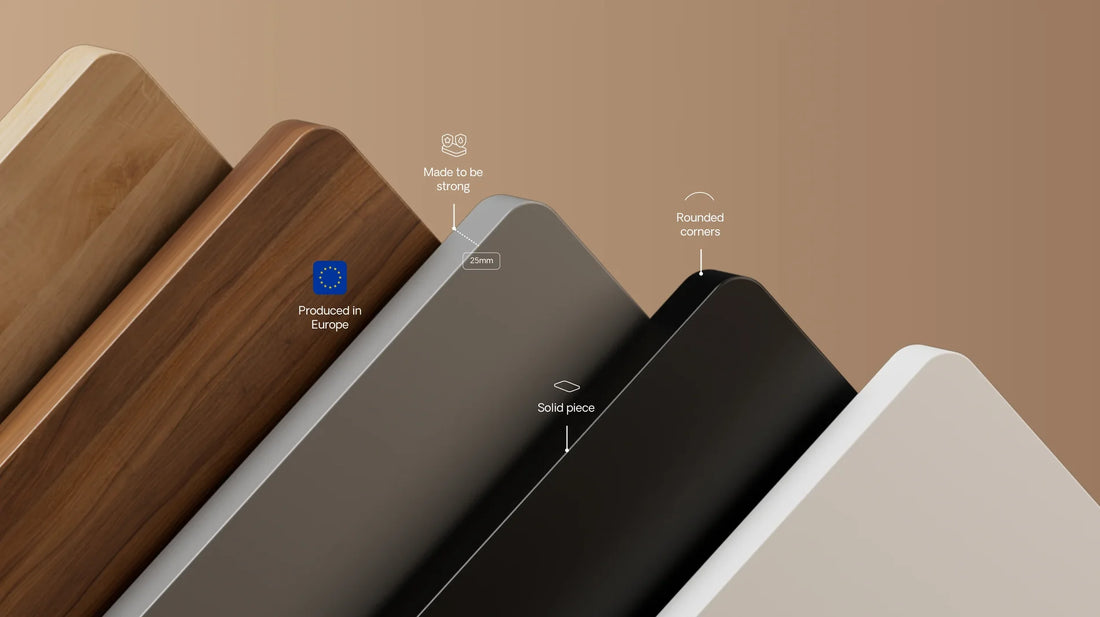
The desktop defines the visual style. The edge finish protects the surface. But the frame and legs are what support your entire workday.
For Australian users, the standing desk frame is no longer just a premium office furniture item. It is becoming a practical foundation for home offices, hybrid work and modern workplace upgrades.
Choosing a Shappa Standing Desk Frame means choosing more than a desk that goes up and down. It means choosing a more stable, flexible and long-lasting workstation for everyday work.
→ Browse Shappa standing desk frames: MS1 · MS2 · MO2 · View all frames
